We use cookies on this site, but we don't capture any personal information. View cookie options.

What happens if you decline cookies?

Like most people, I use Google Analytics to see how my web site is used, but this doesn't capture any personal information about you, and I certainly don't gather data about you in any other way without telling you. There's no hidden market intelligence stuff on the site. But you can decline cookies if you really want to, and I'll suppress Google Analytics.

Please state your preference below.
(Clicking 'Accept cookies' gets rid of that annoying top bar.)

My site also uses essential cookies, which are permitted under UK law. You can override them in your browser settings, but the site probably won't work properly if you do.
For more information, see my Privacy policy page.

Current status:

Accept cookies     Decline cookies      Reset     Close


Is this forbidding?

Forbidding Sky

What’s wrong with this sentence:

 “They struggled on beneath a foreboding sky.”

Answer:

Well, nothing. It’s a perfectly valid sentence … in theory. But it’s not what the writer meant. It should have read:

“They struggled on beneath a FORBIDDING sky.”

Hang on! How do I know what the author meant?

OK, I don’t; but I can make a pretty good guess. I’m willing to bet that on nine occasions out of ten, the author meant “forbid” in one form or another. He or she substituted “foreboding” for “forbidding” because it sounded somehow more dramatic, more poetic.

So is “to forebode” a valid verb at all?

Actually yes. It means to “portend” or “augur”, or to sense impending problems. You’ll find it in all the dictionaries, along with examples of its use. But let’s get real; its occurrence as a verb in modern times is extremely rare. Admittedly, you might sometimes encounter it in a sentence like this:

“The ripple of unease in the crowd seemed to forebode evil.”

This is theoretically valid, but in my book it’s archaic and awkward. Safer alternatives would be “portend” or “foretell” or “presage”. Ironically, to some extent “forebode” feels awkward here precisely because it sounds too much like “forbid”, which can make any sentence containing it potentially confusing.

What about “foreboding” as an adjective?

Yes, OK, “foreboding” is a valid participial adjective derived from “forebode”. But if you apply it to an inanimate object, you have to think carefully about what you actually mean. Can a sky really be foreboding? The simple answer is not in itself. The sky doesn’t have any knowledge or feelings, and its appearance can’t be taken as a portent of much more than upcoming weather conditions.

This is pathetic (not)

It’s the observer commenting on the sky who actually feels a sense of foreboding (noun); but that sense is attributed to the sky (adjective). You could argue that this is a case of what linguists call pathetic fallacy. (That’s pathetic as in “pathos”, not as in “contemptible”.) The foreboding is being transferred from the observer to an external object, atmosphere or feeling. And as far as I’m concerned, when it comes to the word “foreboding”, this kind of attribution is so subtle, and its use is so often likely to be questionable, that it’s best avoided altogether.

“Foreboding” as a noun: the only safe bet

For all practical purposes, you’re safest if you limit the use of “foreboding” to the noun. (Technically it’s a verbal noun, or a gerund.) Quite honestly, you’re playing with fire if you use it in any other way.

Foreboding, n. A feeling of uneasy anticipation; a sense of impending doom.

“Glancing up at the forbidding sky, he was suffused with a sense of foreboding.”

If you talk about “a foreboding sky”, you’re likely to upset pedants like me, and confuse people who don’t know the difference into thinking that “foreboding” and “forbidding” mean more or less the same thing. They don’t, and misleading people simply devalues the language.


Author’s note

As you can see, I’m an unrepentant lifelong pedant, but insistence on correctness has helped me immeasurably with my writing, and I can’t be so different from everyone else. So I’ve decided to share a few insights here in a vainglorious attempt to make the world a more comprehensible place.

If you’d like to suggest any other grammatical howlers that I could expose, please leave a comment or drop me a note here. I’d love to hear from you.

And you can decide for yourself whether I live up to my own tenets by checking out my novels. See peterrowlands.com.



Posted in Grammar | Tagged | Leave a comment

This is not my cat

Ceci n’est pas mon chat (image courtesy Wikimedia Foundation*)

Who am I?

Am I a man or a woman? Am I thirty, fifty or seventy years old? Who are my favourite writers? How well am I progressing with the job of crafting my next novel? What is the name of my cat?

Obviously you must know my gender. My name, Peter Rowlands, is a pretty good clue, and so are the pictures of me on my website. But as for the rest, if you’re a reader who came across my books on the internet, do you care?

Well, a lot of my fellow-writers believe you do. They go to great lengths to keep their own readers informed about what they’re thinking and doing, and how well they’re getting on with their latest book. They blog, they post, they maintain a lively Facebook feed, they send out informative newsletters … In short, they make a continuous effort to ensure that they remain a part of their readers’ lives even when those readers aren’t actually reading one of their books.

I do very little of this, and the lack of public profile worries me. Am I short-changing my readers? More to the point, am I short-changing myself by missing out on the exposure I might be getting?

Extremely boring!

In the past, I’ve justified my policy of keeping a low profile by telling myself that what readers want from me is my books, not my biography or details of my daily life. They would find the latter extremely boring! That’s why I put the majority of my efforts into my novels as opposed to commentary on my life beyond them.

I suppose I take my cue from my own reading experience. For the most part, I’m perfectly happy for the authors I read to remain more or less a closed book to me, if I can put it that way. I might want to know if they’re male or female (or something more nuanced). I might be interested in their nationality, just to get an insight into their use of language. And I suppose I’m interested to know if they’re very young or very old, since that might provide extra insight into their take on life.

Seldom the gods I imagined

But beyond that, I almost prefer writers to remain a mystery. In fact if I chance to see a photograph of an author I’ve been reading, I’m often disappointed. They seldom look as charismatic or attractive as the leading characters they’ve created for me, and sad to say, they’re often older than I thought. Finding that they’re not the gods I imagined, but mere mortals, is usually an anticlimax. I prefer to stick to my own mental picture of them, even if it’s as fictitious as the work they’re turning out.

But really I’m just being lazy!

Yet even as I say all this, I know that basically I’m being lazy. I know perfectly well that in the social media age, having a profile is essential. I can’t claim some principled reason for keeping my head down; I’m doing it simply because anything more than the basics would seem an enormous effort for an uncertain reward. Yet that means I’m falling short in terms of basic marketing strategy.

I suppose the remedy is there if I want to make the effort. I just have to try harder! But until I take my own advice, I have to hope that for most of my readers my books alone will be enough.

Not my cat

By the way, for those who are desperate to know, I don’t have a cat.

*Image by Matti Blume, Wikimedia Foundation


Posted in Discussion | Tagged , , | Leave a comment

Be it so

Before or After? (image courtesy Wikimedia Foundation)

Spot the mistake in this sentence:

“It is vitally important that the community hall has a new roof.”

Answer:

We don’t know whether the community hall desperately needs a new roof, or already has a new roof. If it still needs the new roof, the form should be:

“It is vitally important that the community hall HAVE a new roof.”

OR

“It is vitally important that the community hall SHOULD HAVE a new roof.”

What’s going on here?

Historically, expressions that conveyed suggesting, demanding or necessity were followed by a subjunctive verb: “I demand that he HAND it over,” not “I demand that he hands it over.” Yeah, it probably sounds fussy and pedantic, and maybe reminds you of something you learned in Latin. But the fact is that it can still help to make the meaning clearer.

So what’s a subjunctive anyway?

Verbs tend to come in three main flavours or “moods”:

Indicative – This is the usual mood: a statement about how things are
Imperative – An instruction or command (e.g. “Hand it over!”)
Subjunctive – A statement about how things should be, or how we would like them to be

Simplistically speaking, you create a subjunctive verb by lopping the S off the end of singular verbs, or changing singular irregular verbs to what looks like the plural. So we have “It is essential that he GIVE (not gives) me some money,” and “It is vital that he HAVE (not has) his membership withdrawn.”

And I’m seriously suggesting you should use this?

OK, no. If you’re worried about sounding like an eighteenth century linguistic pedant, you can use an auxiliary verb instead: “It is vital that he SHOULD HAVE his membership withdrawn.” This skirts the issue and still makes the point. All I’m suggesting is that anyone using expressions involving necessity, intent and so on make (not makes!) the meaning crystal clear.

The Americans have this nailed

It seems that American speakers are more comfortable with subjunctives than the British, and can actually feel it awkward if someone uses the indicative mood when a subjunctive is required. I salute them!

A final word

You might think this post is about splitting the finest of hairs, but I’ve often heard snatches of news reporting where I genuinely didn’t know whether the speaker was expressing desire for something to happen or gratitude that it had happened already. And that’s not clever.

Oh, and …

“Be it so”, the title of this piece, is apparently a rather archaic direct subjunctive form, which in modern usage would be translated into “Let it be”. And that, as I’m sure you didn’t want to know, is a third-person imperative.


Author’s note

As you can see, I’m an unrepentant lifelong pedant, but insistence on correctness has helped me immeasurably with my writing, and I can’t be so different from everyone else. So I’ve decided to share a few insights here in a vainglorious attempt to make the world a more comprehensible place.

If you’d like to suggest any other grammatical howlers that I could expose, please leave a comment or drop me a note here. I’d love to hear from you.

And you can decide for yourself whether I live up to my own tenets by checking out my novels. See peterrowlands.com.



Posted in Grammar | Tagged | Leave a comment

Why I won’t watch on

The watch is on

Watch on Wrist (image courtesy Wikimedia Foundation)

Spot this mistake in this sentence:

“The tennis star lost the set love-six as thousands watched on.”

Answer:

The verb “watch” doesn’t have or need a follow-on particle (the “on” bit). It’s complete in itself.

“The tennis star lost the set love-six as thousands watched.”

So what’s going on?

People like the cadence of an expanded verb (technically a “phrasal verb”). These usually mean more than the naked verb itself. Hence “poured out” and “sat down”. Until recently the verb “watch” didn’t have a follow-on particle, but apparently it didn’t feel weighty enough without one, so people added “on”. TV commentators are especially fond of this form. And of course a parallel example was already in wide use: to “look on”. People simply forced “watch” to take the same route.

But that’s not what it means!

There’s a special problem here, because strictly speaking, adding “on” to “watch” changes its meaning. The phrasal verb “to look on” has come to mean “to watch impassively”. By way of example, you could say that Nero looked on (actually he fiddled) as Rome burned. The verb “watch”, by contrast, doesn’t have this kind of dispassionate overtone. The feelings of the watcher depend on the context.

It sounds like “looked on”

The trouble is that when you say “watch on”, it sounds like “look on”, and acquires a similar nuance. It suggests that the observers are doing it impassively. In almost every case, that’s absolutely not what the writer or speaker means. It’s a linguistic contradiction. If thousands watched on as a tennis star crumbled, it sounds as if they were doing it with supreme indifference – the exact opposite of what almost certainly happened.

Do we care?

Dictionaries such as Merriam-Webster accept “watch on” as a legitimate form because it’s so widely heard; but this doesn’t mean that using it is helpful or desirable. It’s an example of what’s known as “linguistic creep”. It muddies the precision of the language we had before.


Author’s note

As you can see, I’m an unrepentant lifelong pedant, but insistence on correctness has helped me immeasurably with my writing, and I can’t be so different from everyone else. So I’ve decided to share a few insights here in a vainglorious attempt to make the world a more comprehensible place.

If you’d like to suggest any other grammatical howlers that I could expose, please leave a comment or drop me a note here. I’d love to hear from you.

And you can decide for yourself whether I live up to my own tenets by checking out my novels. See peterrowlands.com.



Posted in Grammar | Tagged | Leave a comment

Just because …

Man with Megaphone (bus by Corgi)

Spot the mistake in this sentence:

“Just because everyone else makes this mistake doesn’t mean you have to do the same.”

Answer:

That sentence doesn’t have a subject! What exactly “doesn’t mean you have to do the same”? Grammatically speaking, you can’t make a qualifying clause (“Just because…”) the subject. You need a noun or a pronoun.

“Although everyone else makes this mistake, THAT doesn’t mean you have to do the same.”

OR

“THE FACT THAT everyone else makes this mistake doesn’t mean you have to do the same.”

OR

“Just because everyone else makes this mistake, YOU don’t have to do the same.”

The problem:

People are allowing phrases beginning with “Because” to float away into a kind of grammatical nebula, and are continuing their sentences with what they would like to have said, not what they actually did say. It happens more in the spoken word than in writing. Simplify it, and you get something like:

“Because this is black means it isn’t white.”

It sounds a bit weird, don’t you think?

Seriously? Do we care?

Among grammatical mistakes, this is probably one of the least problematic. Everyone knows what incorrect sentences like this mean, and people have been using this type of construction (or misconstruction?) forever. So why should we care?

It’s because “just because” will immediately trigger an alarm bell in the minds of people like me who prize clarity. We’ll be waiting to see if the sentence finishes correctly instead of listening to hear the point that is being made.

What’s that you say? “Get a life” or similar?

I hear you.

The megaphone effect

But there’s a bigger point at issue here. Slips in the clarity of speech and writing tend to be amplified by people with a metaphorical megaphone – broadcasters, politicians, pundits, influencers. The pragmatists will argue that this is how grammar evolves, and we should accept it with a shrug. Maybe, up to a point; but let’s keep constantly in mind that we don’t have to drift into careless speech and writing “just because everyone else does.”

That’s definitely a slippery slope.


Author’s note

As you can see, I’m an unrepentant lifelong pedant, but insistence on correctness has helped me immeasurably with my writing, and I can’t be so different from everyone else. So I’ve decided to share a few insights here in a vainglorious attempt to make the world a more comprehensible place.

If you’d like to suggest any other grammatical howlers that I could expose, please leave a comment or drop me a note here. I’d love to hear from you.

And you can decide for yourself whether I live up to my own tenets by checking out my novels. See peterrowlands.com.



Posted in Grammar | Tagged | Leave a comment

And and is good

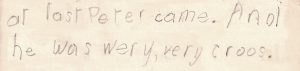
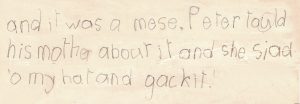
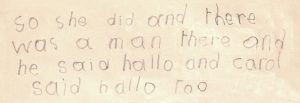
From Peter in the Wood, by Peter Rowlands (my 5-year-old self)

Spot the fault in this sentence:

“While packing his suitcase, he threw in a jacket, a shirt, a tie, and added his electric shaver.”

Answer:

There should be another AND!

While packing his suitcase, he threw in a jacket, a shirt, AND a tie, AND added his electric shaver.”

The problem

A lot of people seem terrified of repeating “and” in their speech and writing. My guess is that they’re reverting unconsciously to their childhood. Little children are apt to pile sentences together with “and”.

“I saw Davy and we played with my toy car and it was a lovely day and Davy was horrid to me … and … and … and …”

As we get older, we’re told not to do this. But surely as grown-ups we’re wise enough to resist following childhood rules by rote, regardless of whether or not they actually apply?

The rule that does apply

In this case we’re looking at a list: jacket, shirt and tie. The grammatical rule for this is clear. Each item in a list must be the same part of speech. Here it’s a noun or noun phrase. But the incorrect sentence bangs a VERB on the end: “added”. If you break it down, it’s saying “He threw in … an added.” But what’s an added? It makes no sense! In effect, “added his electric shaver” is a separate sentence or sub-sentence, which means the original sentence (the list) should be completed first, with its own concluding “and”.

Faulty parallelism

Technically, it’s an instance of faulty parallelism. It’s matching a list of nouns (jacket etc) with a verb (added). Apples and oranges. Horrible!

Why does it matter?

OK, you might say, but we all know what the sentence means, so why does this matter? The reason is that every time you make this mistake, you’re causing a little mental swerve in the minds of your readers or listeners. They may barely notice, but the fact is that they’re expecting the last item in the list to be another noun, yet they’re actually being given a separate sub-sentence. You’re making their life that little bit harder.

Be brave! Defy the masses who get this wrong. Give that extra “and” its day in the sun! Your audience will thank you subconsciously, even if they don’t know it. Make your writing that bit clearer, sharper AND less burdensome, AND don’t give in to the fear that you’re breaking a childhood rule.

You’re not.

But hang on – what about this?

“He battled with rain, wind, fire, earthquakes, marauding locals, injury, starvation, and still came out on top.”

This is a perfectly legitimate sentence, even though there’s no concluding “and” in the list. However, it’s a different kind of sentence from my original example.

It’s considered
The writer is aiming for dramatic effect. The omission of “and” is intentional, flinging extra emphasis on the second part of the sentence.

The list is open-ended
The implication is that there are other adversities that haven’t been mentioned. Putting “and” before “starvation” would create a notional “boundary”, suggesting that the list is complete. Omitting the “and” gives all the items equal weight, and leaves open the possibility that there could have been more of them. There’s an invisible ellipsis (dot dot dot) after “starvation”.

This special rhetorical omission of “and” at the end of a list doesn’t justify leaving it out by mistake! In the real world, that’s what normally happens.


Author’s note As you can see, I’m an unrepentant lifelong pedant, but insistence on correctness has helped me immeasurably with my writing, and I can’t be so different from everyone else. So I’ve decided to share a few insights here in a vainglorious attempt to make the world a more comprehensible place.

If you’d like to suggest any other grammatical howlers that I could expose, please leave a comment or drop me a note here. I’d love to hear from you. And you can decide for yourself whether I live up to my own tenets by checking out my novels. See peterrowlands.com.


Posted in Grammar | Tagged | Leave a comment

Why grammar always matters

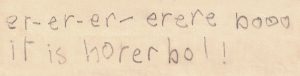
From Peter in the Wood, by Peter Rowlands (my 5-year-old self)

“I have laboured to refine our language to grammatical purity, and to clear it from colloquial barbarisms, licentious idioms, and irregular combinations.”
— Samuel Johnson, 1752

“Let schoolmasters puzzle their brain
With grammar, and nonsense, and learning,
Good liquor, I stoutly maintain,
Gives genius a better discerning”

— Oliver Goldsmith, 1773

The two comments above, both written more than 250 years ago, reflect two diametrically opposed views of English grammar. Lexicographer Samuel Johnson was determined to preserve linguistic purity at all costs, whereas the attitude of the character in that Oliver Goldsmith play is “Who needs it?” It’s a debate that still rages today.

Cards on the table: while I can’t embrace Johnson’s rigidly prescriptive attitude, I strongly believe that communication demands grammatical rules. Without them, we’d never understand each other. And if that’s the case, why insist on applying some rules but not others? That’s the crux of the matter isn’t it?

Appropriate and effective

Bill Bryson, the noted travel writer and advocate of clear communication, takes a nicely pragmatic view. In his book Mother Tongue he says, “Good English is what is appropriate and effective, not what conforms to a set of rules fabricated by 18th-century pedants.” But he qualifies this in his Troublesome Words by saying, “Consideration for the reader should be the writer’s guiding principle. If you take the trouble to write clearly, accurately, and concisely, you are paying your reader a compliment.”

All well and good; but my worry is that the laissez faire approach is becoming entrenched. Language, so the argument goes, constantly evolves, so however much you want to apply rules to it, they should be left to define themselves according to how the language is actually used. In other words, forget about precepts; just go with the flow.

How relaxed should we be?

Really? So how far should we take this? Should formal writing embrace slang words, abbreviations, ambiguities, unfinished thoughts, specious arguments, internal contradictions, collapsed grammatical constructions?

Thankfully it usually doesn’t. Writers and speakers tend to be self-policing. They want to get their points across to their audience, so they follow their own system of grammatical rules as best they can – and generally speaking it’s a system recognised by everyone else.

But sometimes the clamour of populism blurs the boundaries between best practice and easy options, and tempts (or bludgeons) writers into lowering the bar when it comes to the rules they respect. They do it simply because that’s what everyone else does, or because they’re too young to remember a better, clearer way to express themselves.

Rules that help with clarity

However, changes in usage are not always driven by populism. Sometimes people break rules that are still as relevant today as they always were, but that those people have simply forgotten, or never knew in the first place because they were never taught them in school. Or it’s simpler than that. It’s just that people are getting careless about the clarity of what they write or say.

Lack of self-monitoring and a tendency to deliver long, convoluted sentences that are often hard to keep on track is often the fault here. No! The subject of that sentence was plural, not singular! Did you notice? I always do. The sentence should finish, “… ARE often the fault here.” It’s a mistake that’s heard a lot, especially in radio and TV interviews.

That rule (matching subject with verb) is the kind that no one has consciously thrown away, but people are simply missing because they’re not thinking carefully enough about how they express themselves. Getting these rules wrong will cause some of the more fussy and nitpicking people among the audience (oops – that sounds like me) to blink twice instead of taking on board the point that’s being argued.

Getting them right will help to get the message across.

A lost cause?

My campaign is a lost cause; I know that. Trying to turn the tide of decline in grammatical rigour is like trying to push water uphill. But in a way, that’s not my purpose. If people want to use “like” as a conjunction, I can’t stop them. It’s not like I even want to. (Not much!)

What I’d love to do in this grammar blog series, though I don’t have much of a platform to achieve it, is to offer a few snippets of wisdom about rules that help with comprehension; rules that won’t hurt in the observance; rules that infuriate me in the breach; and rules that simply smooth the flow of prose.


Posted in Grammar | Tagged | Leave a comment

Both … but also

Spot the fault in this sentence:

“She bought both the yellow dress but also the red pullover.”

Answer:

“Both” should always be followed by “and”, never “but”.

“She bought both the yellow dress AND the red pullover.”

The problem:

People are confusing two different expressions:
“Both … AND …”
“Not only … BUT also …”

What’s going on?

It’s a familiar problem. People are losing faith in the power of language. They think “both … and …” sounds weak. They want to emphasise the “and” part of their statement, so they preface it with “but” instead. Politicians are particularly prone to doing this during interviews. They’re mangling language in their desperation to sound strong and impactful.

Collapse of logic

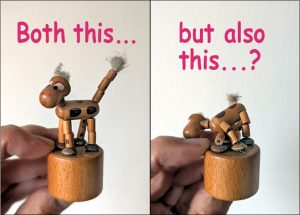
“Both … but …” is a collapse of logic. It’s a bit like what happens with the the push-puppet I’ve illustrated above. You press your thumb on the button underneath and everything falls apart. In speech and writing, what falls apart is comprehensibility.

Why this is wrong

“Both” is a coupling word, connecting two statements or propositions. The only link word that can follow it is “and”. The “and” part of the statement has no logical impact on the initial “both” part. Each exists on its own.

“But” is negating word. It contradicts whatever has come before it, or qualifies it by introducing a new thought that may change the overall thrust of the sentence. It looks both forward and back.

Connecting “both” with “but” reduces the sentence to a logical impossibility. It’s like trying to imagine a car that is driving both ways at the same time.

The solution

Easy! Either say, “She bought BOTH the yellow dress AND the red pullover,” or say, “She bought NOT ONLY the yellow dress, BUT ALSO the red pullover.”

Just ask yourself …

Would you say, “I’ll have EITHER this dress AND that pullover.” Of course you wouldn’t. So don’t say, “Both … but …”


Author’s note

As you can see, I’m an unrepentant lifelong pedant, but insistence on correctness has helped me immeasurably with my writing, and I can’t be so different from everyone else. So I’ve decided to share a few insights here in a vainglorious attempt to make the world a more comprehensible place.

If you’d like to suggest any other grammatical howlers that I could expose, please leave a comment or drop me a note here. I’d love to hear from you.

And you can decide for yourself whether I live up to my own tenets by checking out my novels. See peterrowlands.com.


Posted in Grammar | Tagged | Leave a comment

Would you read an AI-generated novel?

How appealing could a novel written by artificial intelligence be?

That might seem a question for the future. As I write this there aren’t many AI-generated novels around. But there are some, and soon there will be many more. So if you encountered one that appealed to you, would you read it?

Cards on the table: if I heard about an AI-generated novel that was really convincing and was written in a genre I liked, I can easily imagine myself reading it out of sheer curiosity. But this would not be because I thought this is how novels ought to be created; far from it. As a novelist myself, I would simply want to know what I was up against.

Just how good, I would be wondering, was the quality of the AI writing? How sophisticated was the character development? How well was the plot worked through? How correct, how consistent, how idiosyncratic, was the prose? Would I end up with a sense of who the author was, and a feel for his or her vision of the world? Would that even be possible?

My worry, of course, is that the book might pass all these tests and read like something that had emerged directly from a human mind. If it did, where would that leave real human authors like me?

The power of artificial intelligence

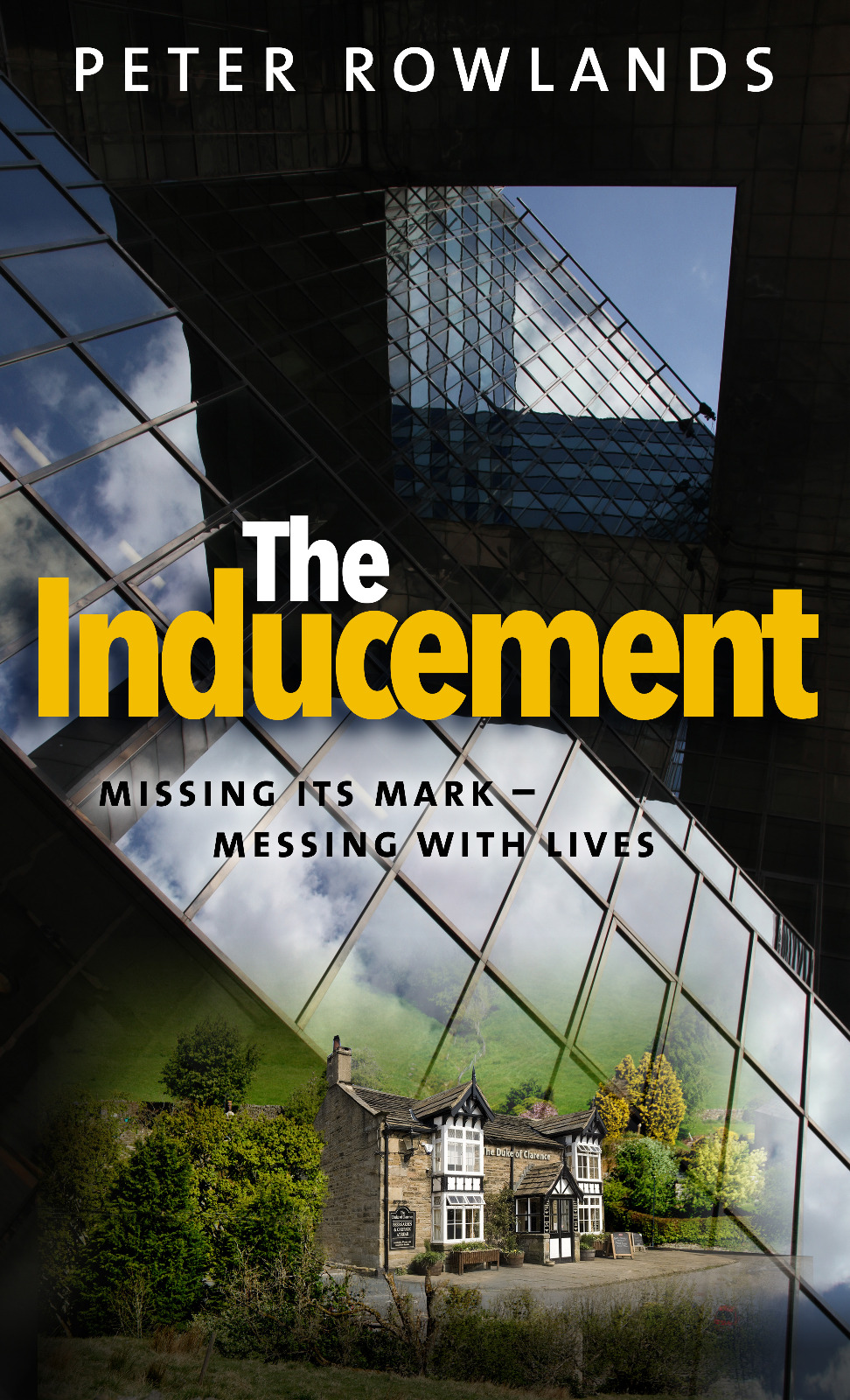
The Inducement by Peter Rowlands - front cover

No artificial intelligence
used here!

I’ve touched on the power of artificial intelligence in my latest novel, The Inducement, which should be published soon after I post this; but I can already see that I will want to return to the subject in more detail in another book.

It’s worth bearing in mind that broadly speaking, artificial intelligence still needs a helping human hand if it’s going to be effective. In theory you could instruct an AI program to write a novel simply by issuing a few lines of guidance; but in practice you would probably fine-tune its suggestions, giving it a steer by providing clues about subject, settings, characters, scope, pace, direction and outcome.

A literary cyborg?

However, in a way this is more worrying than the notion of a book written with virtually no human involvement at all. In practice, we’re looking at a world where the underlying vision of a work will still come from a human author, but the execution will be done by AI, which will churn out the actual words. The outcome will be a weird kind of hybrid – a literary cyborg.

This puts me in mind of various existing best-selling authors, who come up with the basic concept, then work with collaborators who do the hard yards of actually turning their ideas into prose. James Paterson, for instance, is known to take this approach. And historically, there have been strong parallels in the world of art, where masters such as Rubens ran entire workshops of artisans to flesh out the detail of their paintings.

But at least creators like these have used humans with training, skill and experience to flesh out their ideas. What will happen if, instead of using human associates, writers of the future increasingly rely on AI to do the real grafting? Where will the humanity be then?

Recombining and recycling

You might argue that if the prose reads confidently and convincingly, there’s nothing wrong with it. But as many commentators have pointed out, AI will be basing its output on the efforts of countless existing writers and their work. It will be presenting what an author might typically write in this sort of situation, not what a real live author is writing now, in an actual situation. It will be recombining and recycling, not striking out and innovating to produce genuinely new work.

Perhaps we should be glad. If AI really does end up thinking for itself, and comes up with what looks like startlingly creative, ground-breaking new writing, where will that leave mere mortals?

By the way, if you think this sounds like cloud cuckoo land, you haven’t been paying attention. Artificial intelligence can already write frighteningly plausible, convincing prose that looks indistinguishable at first (and second) sight from human-generated prose. The grammar and syntax of the writing will be correct, and it will have natural-sounding rhythm and flow. This kind of thing is now ubiquitous: just look at Chrome’s AI answers to browser queries, or Amazon’s AI summaries of product reviews.

Weakness in content, not composition

If there are weaknesses in current AI-generated text, they tend to lie in the content, not the technique. Analysts will point out that AI writing tends to be general in scope rather than specific; that it equivocates; that it sometimes falls back on clichés. Maybe so, but it will get better at hiding or eliminating these faults, and if you’re not looking hard enough, you might not notice them anyway.

It’s worth reflecting on who will benefit most from AI in terms of novel-writing. It’s going to be people who are poor at spelling; who make mistakes in grammar; who can’t write fluent, rhythmical prose; or who simply can’t type very fast. Clever AI promises to be a leveller. It will allow people who never had a chance of competing at novel-writing before to get into the game, and perhaps come out ahead – potentially leaving writers who are good at these things struggling to keep up.

So far, organisations like Amazon have tried to resist or at least flag up AI-generated content in books, but who knows what will happen in the future?

Not a luddite if you oppose it

One could argue that the advance of AI is already unstoppable, and that the people fighting it are simply luddites. I can’t agree. The textile machines the actual Luddites in Nottinghamshire feared weren’t emulating human creativity, they were merely outpacing humans in terms of replicability and speed of output. By contrast, AI-generated fiction is reducing creativity to a commodity that can be weighed, measured and served up on a plate. Not the same thing at all.

Don’t get me wrong. I accept that AI can be a wonderful force for good. But if we accept it without question in the arts, we’ll be compromising the opportunities for future human creativity, and dumbing down the work we all end up consuming.

While doing research for this post I watched several YouTube videos of people analysing AI-generated writing, and pointing out how to recognise it. There was an extreme irony in the fact that in each case, the video was interrupted several times by advertisements for products that could help people to create AI-generated text: the very thing the videos were warning us about.

The power of the algorithm.


Posted in Discussion | Tagged , | Leave a comment

Blackmail – best crime if you want to escape detection?

The new Mike Stanhope mystery is now available!

No Logical Connection
Blackmail – where it all begins.

If you’re the victim of crime you go to the police. In theory, anyway. But what if you’re being blackmailed? That’s another question – one that comes up in my new novel, No Logical Connection.

The problem is that the police might make public the thing you’re being blackmailed about. That’s the essence of blackmail, isn’t it? Without that fear, it simply won’t work.

Maybe you had an affair with your secretary or your doctor, or leaked business secrets. The police won’t necessarily care about these things, but an indiscreet word from them might still give the game away.

But what you’re being blackmailed over something illegal – maybe a crime you committed a long time ago? How can you persuade the police to investigate the blackmailer without also investigating you?

The answer is that you can’t. However much you play it down, the police will at least be curious; and if they scent criminal activity on your part, they’re sure to start taking an active interest. Don’t forget, they already know who you are, whereas the blackmailer may be an unknown quantity. To them you’ll look an easier target.

You can’t murder a website

If you’re genuinely innocent of the alleged crime, you might feel you can leave the police to investigate you to their hearts’ content, so long as they also pursue the blackmailers.

But what if you’ve been carefully set up by the blackmailers? What if they’ve created a convincing trail of planted evidence and fake information? That might make you think again.

Guilty or innocent, plenty of blackmail victims in fiction end up attempting to kill the blackmailer in their effort to fend off the threat. Sometimes they succeed.

But suppose the blackmailers are hiding on the internet. Cybercrime adds a whole new dimension to the theme. You can’t murder a website or social media feed to fend off the attack. The blackmailers can post anything they like about you, and simply defy you to refute it.

They don’t even have to upload their supposed evidence; they can just threaten to. They can say they’re going to allege that you embezzled funds from a charity, or bought and sold illegal pornography. You can deny it all you like, but sadly, a lot of people are likely to believe it. Mud sticks.

More prevalent than it’s ever been

Which is why the threat of such blackmail is more prevalent now than it’s ever been; and why I’ve chosen it as one of the themes that kick off No Logical Connection, the latest Mike Stanhope mystery drama (number 7 in the series), which is now available.

A distant colleague of Mike’s is being blackmailed over his alleged involvement in illegal pornography, and turns to Mike for help. But with Mike, life is never simple. He tends to look for connections where none seem to exist; and in this case there are plenty for him to chase up.

I think his efforts make this one of the most intriguing novels yet in the series: one that lays bare the insidiousness of the online blackmail threat, and also teases with the possibility that in this case there might be some kind of logic in the seemingly random events that surround it.

I hope you agree!


Posted in Discussion | Tagged , , | Leave a comment


Welcome to my blog!

Commentary on writing, self-publishing, books, and the wider world.

Writer’s rant

Fancy reading a grumble about the unwitting mistakes people make in speech and writing? See 
Writer’s Rant page.

Main blog topics

More posts


Past posts


© Peter Rowlands 2026


Peter Rowlands on Facebook Peter Rowlands on Twitter

About me

Contact me


Sitemap

Reset cookies


© Peter Rowlands 2026


Peter Rowlands on Facebook Peter Rowlands on Twitter


About me

Contact me


Sitemap

Reset cookies