

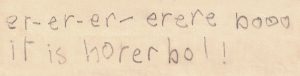
From Peter in the Wood, by Peter Rowlands (my 5-year-old self)
“I have laboured to refine our language to grammatical purity, and to clear it from colloquial barbarisms, licentious idioms, and irregular combinations.”
— Samuel Johnson, 1752
“Let schoolmasters puzzle their brain
With grammar, and nonsense, and learning,
Good liquor, I stoutly maintain,
Gives genius a better discerning”
— Oliver Goldsmith, 1773
The two comments above, both written more than 250 years ago, reflect two diametrically opposed views of English grammar. Lexicographer Samuel Johnson was determined to preserve linguistic purity at all costs, whereas the attitude of the character in that Oliver Goldsmith play is “Who needs it?” It’s a debate that still rages today.
Cards on the table: while I can’t embrace Johnson’s rigidly prescriptive attitude, I strongly believe that communication demands grammatical rules. Without them, we’d never understand each other. And if that’s the case, why insist on applying some rules but not others? That’s the crux of the matter isn’t it?
Appropriate and effective
Bill Bryson, the noted travel writer and advocate of clear communication, takes a nicely pragmatic view. In his book Mother Tongue he says, “Good English is what is appropriate and effective, not what conforms to a set of rules fabricated by 18th-century pedants.” But he qualifies this in his Troublesome Words by saying, “Consideration for the reader should be the writer’s guiding principle. If you take the trouble to write clearly, accurately, and concisely, you are paying your reader a compliment.”
All well and good; but my worry is that the laissez faire approach is becoming entrenched. Language, so the argument goes, constantly evolves, so however much you want to apply rules to it, they should be left to define themselves according to how the language is actually used. In other words, forget about precepts; just go with the flow.
How relaxed should we be?
Really? So how far should we take this? Should formal writing embrace slang words, abbreviations, ambiguities, unfinished thoughts, specious arguments, internal contradictions, collapsed grammatical constructions?
Thankfully it usually doesn’t. Writers and speakers tend to be self-policing. They want to get their points across to their audience, so they follow their own system of grammatical rules as best they can – and generally speaking it’s a system recognised by everyone else.
But sometimes the clamour of populism blurs the boundaries between best practice and easy options, and tempts (or bludgeons) writers into lowering the bar when it comes to the rules they respect. They do it simply because that’s what everyone else does, or because they’re too young to remember a better, clearer way to express themselves.
Rules that help with clarity

However, changes in usage are not always driven by populism. Sometimes people break rules that are still as relevant today as they always were, but that those people have simply forgotten, or never knew in the first place because they were never taught them in school. Or it’s simpler than that. It’s just that people are getting careless about the clarity of what they write or say.
Lack of self-monitoring and a tendency to deliver long, convoluted sentences that are often hard to keep on track is often the fault here. No! The subject of that sentence was plural, not singular! Did you notice? I always do. The sentence should finish, “… ARE often the fault here.” It’s a mistake that’s heard a lot, especially in radio and TV interviews.
That rule (matching subject with verb) is the kind that no one has consciously thrown away, but people are simply missing because they’re not thinking carefully enough about how they express themselves. Getting these rules wrong will cause some of the more fussy and nitpicking people among the audience (oops – that sounds like me) to blink twice instead of taking on board the point that’s being argued.
Getting them right will help to get the message across.
A lost cause?
My campaign is a lost cause; I know that. Trying to turn the tide of decline in grammatical rigour is like trying to push water uphill. But in a way, that’s not my purpose. If people want to use “like” as a conjunction, I can’t stop them. It’s not like I even want to. (Not much!)
What I’d love to do in this grammar blog series, though I don’t have much of a platform to achieve it, is to offer a few snippets of wisdom about rules that help with comprehension; rules that won’t hurt in the observance; rules that infuriate me in the breach; and rules that simply smooth the flow of prose.

