

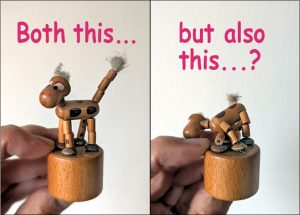
Spot the fault in this sentence:
“She bought both the yellow dress but also the red pullover.”
Answer:
“Both” should always be followed by “and”, never “but”.
“She bought both the yellow dress AND the red pullover.”
The problem:
People are confusing two different expressions:
“Both … AND …”
“Not only … BUT also …”
What’s going on?
It’s a familiar problem. People are losing faith in the power of language. They think “both … and …” sounds weak. They want to emphasise the “and” part of their statement, so they preface it with “but” instead. Politicians are particularly prone to doing this during interviews. They’re mangling language in their desperation to sound strong and impactful.
Collapse of logic
“Both … but …” is a collapse of logic. It’s a bit like what happens with the the push-puppet I’ve illustrated above. You press your thumb on the button underneath and everything falls apart. In speech and writing, what falls apart is comprehensibility.
Why this is wrong
“Both” is a coupling word, connecting two statements or propositions. The only link word that can follow it is “and”. The “and” part of the statement has no logical impact on the initial “both” part. Each exists on its own.
“But” is negating word. It contradicts whatever has come before it, or qualifies it by introducing a new thought that may change the overall thrust of the sentence. It looks both forward and back.
Connecting “both” with “but” reduces the sentence to a logical impossibility. It’s like trying to imagine a car that is driving both ways at the same time.
The solution
Easy! Either say, “She bought BOTH the yellow dress AND the red pullover,” or say, “She bought NOT ONLY the yellow dress, BUT ALSO the red pullover.”
Just ask yourself …
Would you say, “I’ll have EITHER this dress AND that pullover.” Of course you wouldn’t. So don’t say, “Both … but …”
Author’s note
As you can see, I’m an unrepentant lifelong pedant, but insistence on correctness has helped me immeasurably with my writing, and I can’t be so different from everyone else. So I’ve decided to share a few insights here in a vainglorious attempt to make the world a more comprehensible place.
If you’d like to suggest any other grammatical howlers that I could expose, please leave a comment or drop me a note here. I’d love to hear from you.
And you can decide for yourself whether I live up to my own tenets by checking out my novels. See peterrowlands.com.

