

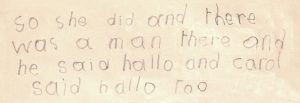
From Peter in the Wood, by Peter Rowlands (my 5-year-old self)
Spot the fault in this sentence:
“While packing his suitcase, he threw in a jacket, a shirt, a tie, and added his electric shaver.”
Answer:
There should be another AND!
“While packing his suitcase, he threw in a jacket, a shirt, AND a tie, AND added his electric shaver.”
The problem
A lot of people seem terrified of repeating “and” in their speech and writing. My guess is that they’re reverting unconsciously to their childhood. Little children are apt to pile sentences together with “and”.
“I saw Davy and we played with my toy car and it was a lovely day and Davy was horrid to me … and … and … and …”
As we get older, we’re told not to do this. But surely as grown-ups we’re wise enough to resist following childhood rules by rote, regardless of whether or not they actually apply?
The rule that does apply
In this case we’re looking at a list: jacket, shirt and tie. The grammatical rule for this is clear. Each item in a list must be the same part of speech. Here it’s a noun or noun phrase. But the incorrect sentence bangs a VERB on the end: “added”. If you break it down, it’s saying “He threw in … an added.” But what’s an added? It makes no sense! In effect, “added his electric shaver” is a separate sentence or sub-sentence, which means the original sentence (the list) should be completed first, with its own concluding “and”.
Faulty parallelism
Technically, it’s an instance of faulty parallelism. It’s matching a list of nouns (jacket etc) with a verb (added). Apples and oranges. Horrible!
Why does it matter?
OK, you might say, but we all know what the sentence means, so why does this matter? The reason is that every time you make this mistake, you’re causing a little mental swerve in the minds of your readers or listeners. They may barely notice, but the fact is that they’re expecting the last item in the list to be another noun, yet they’re actually being given a separate sub-sentence. You’re making their life that little bit harder.
Be brave! Defy the masses who get this wrong. Give that extra “and” its day in the sun! Your audience will thank you subconsciously, even if they don’t know it. Make your writing that bit clearer, sharper AND less burdensome, AND don’t give in to the fear that you’re breaking a childhood rule.
You’re not.
But hang on – what about this?
“He battled with rain, wind, fire, earthquakes, marauding locals, injury, starvation, and still came out on top.”
This is a perfectly legitimate sentence, even though there’s no concluding “and” in the list. However, it’s a different kind of sentence from my original example.
It’s considered
The writer is aiming for dramatic effect. The omission of “and” is intentional, flinging extra emphasis on the second part of the sentence.
The list is open-ended
The implication is that there are other adversities that haven’t been mentioned. Putting “and” before “starvation” would create a notional “boundary”, suggesting that the list is complete. Omitting the “and” gives all the items equal weight, and leaves open the possibility that there could have been more of them. There’s an invisible ellipsis (dot dot dot) after “starvation”.
This special rhetorical omission of “and” at the end of a list doesn’t justify leaving it out by mistake! In the real world, that’s what normally happens.
Author’s note As you can see, I’m an unrepentant lifelong pedant, but insistence on correctness has helped me immeasurably with my writing, and I can’t be so different from everyone else. So I’ve decided to share a few insights here in a vainglorious attempt to make the world a more comprehensible place.
If you’d like to suggest any other grammatical howlers that I could expose, please leave a comment or drop me a note here. I’d love to hear from you. And you can decide for yourself whether I live up to my own tenets by checking out my novels. See peterrowlands.com.

