

Spot the faults in these sentences:
“Me and Sarah went to the shops.”
“The sales person served Sarah and I.”
“Between you and I, this lecturing about grammar sucks.”
Answer:
“I” is a nominative pronoun. It does things; it can’t be the object of a verb.
“Me” is an accusative pronoun. It has things done to it; it can’t be the subject.
“Sarah and I went to the shops.”
“The sales person served Sarah and ME.”
“Between you and ME, this is really helpful!”
Reality check:
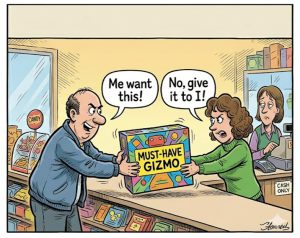
Everyone uses “me” as the subject of sentences now. It’s universal and apparently unstoppable. It started as a slightly jocular twist on proper grammar, and is sometimes also a ruse for putting the speaker at the start of a statement. You wouldn’t say, “I and Sarah went out,” so people say, “Me and Sarah went out” instead. It’s still wrong, but doesn’t sound quite so awful. That being said, why can’t people be polite enough to put Sarah first? What’s wrong with “Sarah and I went out”?
I is a different case (or should that be “I are different case”?)
I think “Give it to Sarah and I” originated with people half-remembering a rule they learned in childhood, but not remembering it right. Unfortunately, it’s heard so often now that people are beginning to think it is the rule.
It’s not.
So does it matter?
The risk is that constant misuse entrenches mistakes. Remember the word “invitation”? People started saying “invite” for short, and now those who don’t remember the real word use “invite” even in formal writing. Yet it’s ugly. Can you imagine receiving a card that says, “This is a formal invite to a royal garden party”? Maybe you can. I can’t!
Just ask yourself …
Would you say, “Me went to the shops”? Would you say “Let I give you a hand with that”?
No you wouldn’t.
Author’s note
As you can see, I’m an unrepentant lifelong pedant, but insistence on correctness has helped me immeasurably with my writing, and I can’t be so different from everyone else. So I’ve decided to share a few insights here in a vainglorious attempt to make the world a more comprehensible place.
If you’d like to suggest any other grammatical howlers that I could expose, please leave a comment or drop me a note here. I’d love to hear from you.
And you can decide for yourself whether I live up to my own tenets by checking out my novels. See peterrowlands.com.

